First, let’s understand: What is plasma technology?
The term "plasma" sounds unfamiliar to many, but it is actually the fourth state of matter besides solid, liquid and gas, also known as electric plasma. In fact, common phenomena like lightning and the glow of neon lights are essentially the effects of plasma.
Plasma technology applied in the field of energy storage materials is mostly low-temperature plasma, which generates energetic active particles such as electrons, ions and free radicals under mild conditions. These micro "elves" can act precisely on the surface or interior of energy storage materials, enabling surface modification, defect regulation and element doping without damaging the overall material structure. The entire process is highly efficient and environmentally friendly, perfectly overcoming the drawbacks of traditional high-temperature modification processes such as high energy consumption and heavy pollution.
Simply put, plasma technology does not take a drastic approach; it only performs precise fine-tuning — yet it can fully unlock the potential of energy storage materials.

Core Applications: How Does Plasma Technology Empower Various Energy Storage Materials?
Plasma technology is now widely applied in the material modification of diverse energy storage devices including lithium-ion batteries, sodium-ion batteries, zinc metal batteries and supercapacitors. It offers targeted solutions to the "pain points" of different materials, with every breakthrough bringing striking results.
1. Zinc Metal Batteries: Doubling the Cycle Life Directly
Zinc metal batteries are regarded as a promising candidate for large-scale energy storage due to their low cost, high safety and environmental friendliness. Their zinc anodes boast advantages such as high theoretical capacity and low redox potential, yet issues like dendrite growth and anode corrosion have hindered the breakthrough of their cycle life and prevented their large-scale application for a long time.
The research team led by Yu Xinyao from Anhui University has provided a perfect solution: using oxygen plasma engineering technology to perform "micro-shaping" on zinc anodes. First, a nanoscale zinc oxide layer is grown on zinc foil via room-temperature oxygen plasma treatment, followed by fluorination, ultimately constructing a zinc oxide/zinc fluoride heterostructure with a built-in electric field.
This simple surface modification delivers stunning effects: the zinc ion conductivity and transference number are greatly improved, the hydrogen evolution reaction is effectively suppressed, and zinc deposition becomes much more uniform. Tests show that the cycle life of the modified symmetric battery has jumped from less than 200 hours to over 2000 hours, and it can operate stably for hundreds of hours even under high current density; the assembled full battery still maintains a high capacity retention rate of 85% after 1000 cycles, far exceeding unmodified batteries
2. Lithium Metal Batteries: Solving the Dendrite Problem and Fortifying Safety Barriers
Lithium metal batteries are hailed as the "next-generation high-energy-density batteries", yet the interfacial instability of their lithium metal anodes has long been a fatal flaw restricting their application—highly reactive lithium undergoes side reactions with electrolytes to form an unstable solid electrolyte interphase (SEI), and the uneven deposition of lithium triggers dendrite growth, which not only causes battery capacity fading but also may lead to safety hazards such as short circuits and fires.
The research team led by Researcher Zhang Yongqi from the University of Electronic Science and Technology of China has found a breakthrough using low-temperature plasma technology: proposing a liquid-source low-temperature plasma strategy to in-situ construct an alloy-based composite SEI with a gradient structure on the lithium metal surface.
This gradient SEI has a clear division of labor and works in synergy: the underlying lithium-tin alloy provides lithiophilic sites and reduces the nucleation barrier; the middle LiF layer facilitates the rapid transport of lithium ions; the surface composite layer enhances interfacial stability. More crucially, it can regulate the crystal orientation of lithium deposition, inhibit dendrite growth from the mechanism, and greatly improve the cycle stability and overpotential control capability of lithium metal anodes. It can even be adapted to Ah-class pouch cells, laying a foundation for the industrialization of high-energy-density batteries
3. Sodium-Ion Batteries: Unleashing Potential for Large-Scale Energy Storage
Sodium-ion batteries have become a popular choice for large-scale energy storage due to their abundant raw materials, low cost and excellent low-temperature performance. Among them, sodium vanadium phosphate is a highly promising cathode material, yet its low electronic conductivity and slow sodium ion diffusion limit its high-rate charge-discharge performance and long-cycle performance.
The research by the team led by Liang Feng from Kunming University of Science and Technology has provided a solution: adopting low-temperature plasma technology to conduct multi-scale synergistic modification on sodium vanadium phosphate cathode sheets. At the micro level, high-energy electrons excited by plasma introduce oxygen vacancies inside the material crystals, reduce the material band gap, and make sodium ion transport smoother; at the macro level, a substance layer with high sodium ion conductivity is in-situ formed at the electrode sheet interface to improve interfacial transport performance.
This breakthrough not only provides a new path for the performance improvement of sodium vanadium phosphate materials but also makes the application of sodium-ion batteries in new energy vehicles, smart grid energy storage and other fields more promising
4. Supercapacitors: Boosting Capacity While Balancing High Efficiency and Stability
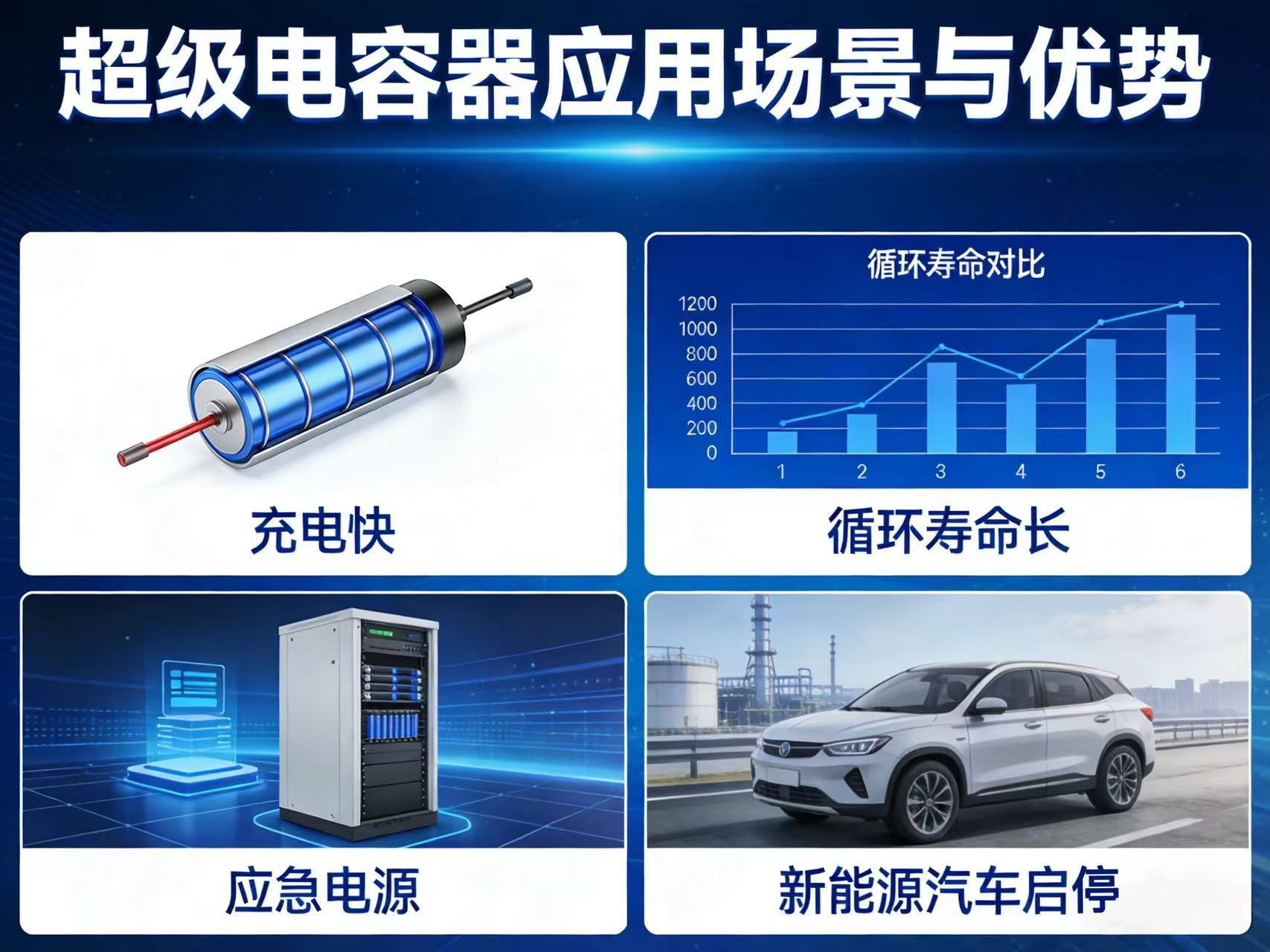
Supercapacitors are widely used in scenarios such as emergency power supplies and start-stop systems of new energy vehicles due to their advantages of fast charging and long cycle life, yet their low energy density has long limited their application scope. Plasma technology is precisely the key enabler to improve their energy density.
Through plasma surface etching, a large number of micropores and defects can be created on the surface of supercapacitor electrode materials (such as graphene and activated carbon), which greatly increases the specific surface area of the materials, enables fuller contact between electrodes and electrolytes, and thus improves the capacitance; at the same time, plasma doping technology can introduce elements such as nitrogen and oxygen into electrode materials, regulate the electronic structure of the materials, and enhance their conductivity and electrochemical activity. This allows supercapacitors to not only retain the advantage of fast charge-discharge but also possess higher energy density and cycle stability.
5. Fusion Energy Storage: Breaking Core Bottlenecks, Laying Out the Ultimate Energy Solution
Beyond the battery sector, plasma technology also plays a pivotal role in fusion energy storage—the ultimate energy source. The "Mega-Joule Class 10kA Forced-Flow Cooled High-Temperature Superconducting Energy Storage Magnet System", successfully developed by the Institute of Plasma Physics, Chinese Academy of Sciences, leverages plasma-related technologies to break key bottlenecks in controlled nuclear fusion engineering. It provides powerful magnetic confinement for the "artificial sun", a core prerequisite for realizing fusion power generation.
This breakthrough has not only reached the international leading level but also unveiled a hundred-billion-yuan industrial blueprint. In the future, it will underpin the development of high-end equipment such as controlled nuclear fusion reactors, large accelerators and high-magnetic-field devices, offering a solution to humanity’s ultimate energy demands.
Current Status and Outlook: Plasma Technology—A Promising Future
Today, the application of plasma technology in the field of energy storage materials has moved from the laboratory to the early stage of industrialization. The performance breakthroughs of zinc and lithium metal batteries, as well as the technological optimization of sodium-ion batteries and supercapacitors, all demonstrate the enormous potential of this technology. It can not only address the longstanding pain points of traditional energy storage materials but also facilitate the R&D of new energy storage materials, driving the upgrade of energy storage technology toward higher energy density, faster charge-discharge speeds and longer cycle life. From the precise modification of vacuum plasma to the low-cost, large-scale application of atmospheric pressure plasma, and from single material processing to the synergistic optimization of the entire electrode interface, the application boundary of plasma technology is continuously expanding, adapting to the needs of multiple scenarios such as power batteries, large-scale energy storage and micro energy storage.
Currently, the integration of technology and industry is accelerating. The miniaturization and modular design of plasma equipment make it easier to integrate into existing energy storage material production lines, reducing the cost of industrial implementation. In-depth research on the interaction mechanism at the material-plasma interface also provides theoretical support for the precise regulation of processes. In the future, with the in-depth combination of plasma technology with artificial intelligence and micro-nano manufacturing, customized regulation of material performance will be achieved, laying a core foundation for the breakthrough of next-generation energy storage technologies such as solid-state batteries and metal-air batteries. Guided by the dual carbon goals, the energy storage industry has entered a golden age of development. As a key core technology empowering the upgrade of energy storage materials, plasma technology is bound to play a greater role in promoting the green transformation of the energy system, boasting a broad and promising future.